
| Page: |
| Home > Help Needed / General Tech Chat > fuel pump wiring | |||||||
 969 Posts Member #: 47 Post Whore Not very sunny swanage |
18th May, 2006 at 08:46:23pm
right guys and girls, have just spent half an hour or so looking through old posts, but i cant find an exact answer so.....
And on the 7th day........... God created turbochargers! |
||||||
|
Site Admin  15302 Posts Member #: 337 Fearless Tom Fenton, Avon Park 2007 & 2008 class D winner & TM legend. |
18th May, 2006 at 09:00:40pm
It is up to you how you want to do it to be honest.
On 29th Nov, 2016 madmk1 said:
On 28th Nov, 2016 Rob Gavin said:
I refuse to pay for anything else Like fuel 😂😂 |
||||||
|
Site Admin 15302 Posts Member #: 337 Fearless Tom Fenton, Avon Park 2007 & 2008 class D winner & TM legend. |
18th May, 2006 at 09:16:19pm
Like so-
On 29th Nov, 2016 madmk1 said:
On 28th Nov, 2016 Rob Gavin said:
I refuse to pay for anything else Like fuel 😂😂 |
||||||
|
1300 Posts Member #: 829 Post Whore essex |
19th May, 2006 at 06:26:44pm
Or like this
1293 Turbo mini
|
||||||
|
Site Admin 15302 Posts Member #: 337 Fearless Tom Fenton, Avon Park 2007 & 2008 class D winner & TM legend. |
19th May, 2006 at 09:16:21pm
All sounds very thought out, however it is not best practise to rely on the relay to break the circuit to the fuel pump, the inertia switch should be placed directly in the feed to the pump so that this ensures a physical break in the supply in the event of an off.
On 29th Nov, 2016 madmk1 said:
On 28th Nov, 2016 Rob Gavin said:
I refuse to pay for anything else Like fuel 😂😂 |
||||||
 9327 Posts Member #: 59 First mini turbo to get in the 12's & site perv Herefordshire |
19th May, 2006 at 09:26:31pm
err mine just comes off the brake light switch live...............
|
||||||
|
969 Posts Member #: 47 Post Whore Not very sunny swanage |
19th May, 2006 at 11:30:31pm
i know that cant be strictly true nic, there must be a switch in there somewhere because iirc you once manganged to forget to turn it on didnt you?!?! :)
And on the 7th day........... God created turbochargers! |
||||||
|
9327 Posts Member #: 59 First mini turbo to get in the 12's & site perv Herefordshire |
20th May, 2006 at 02:10:21am
oh yeah, theres an inline switch in there for security
|
||||||
 249 Posts Member #: 513 Senior Member Sheffield |
19th Jun, 2008 at 12:43:01pm
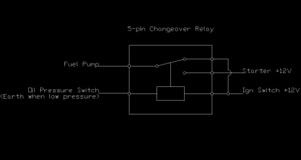
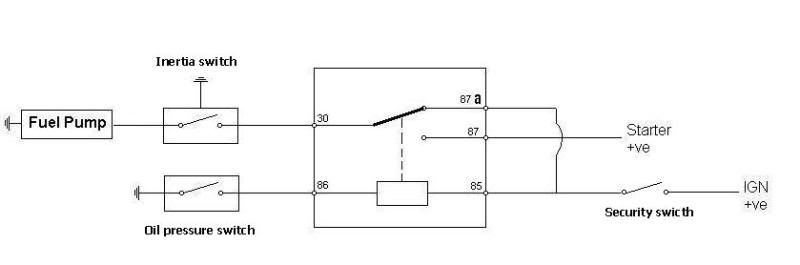
Dragging up and old post here but I can't get my head around how Tom's 5-pin changeover diagram would work given that the oil pressure switch is short on low pressure and goes open circuit at high.
Edited by andygardner on 19th Jun, 2008. |
||||||
 (2)[/url] by [url=https://www.flickr.com/photos/150672766@N03/]Rod Sugden[/url], on Fli) 5988 Posts Member #: 2024 Formally Retired Rural Suffolk |
19th Jun, 2008 at 02:53:27pm
You have 87 and 87a in the wrong positions and show the relay energised (ie, bar pulled toward the coil).
Schrödinger's cat - so which one am I ??? |
||||||
|
Site Admin 15302 Posts Member #: 337 Fearless Tom Fenton, Avon Park 2007 & 2008 class D winner & TM legend. |
19th Jun, 2008 at 03:47:26pm
On 19th Jun, 2008 andygardner said:
Dragging up and old post here but I can't get my head around how Tom's 5-pin changeover diagram would work given that the oil pressure switch is short on low pressure and goes open circuit at high. Trust me, it does work! For e.g. engine stopped, turn ign on, oil pressure is low hence switch is earthed. Therefore you have a current flow through the "coil" of the relay. This pulls the contact across to the terminal connected to the "starter" live. Thus when you turn the ign switch to "start" there is 12v at the terminal which travels through the contact in the relay to the fuel pump which runs for as long as you are turning the key. On releasing the key, the pump is no longer energised and so stops. However there is enough fuel pressure to keep things going for a moment. Assuming your engine is not fucked then oil pressure quickly builds as it is now running. This means the coil in the relay no longer has a current through it, so the contact reverts to its original state, so the fuel pump is now directly fed from the ignition live, jobs a goodun. If at any time the engine loses oil pressure, the coil in the relay is once more energised and so switches the contact, meaning no more power to the fuel pump, and an engine that will cut out shortly afterwards, so almost protecting itself from no oil pressure.
On 29th Nov, 2016 madmk1 said:
On 28th Nov, 2016 Rob Gavin said:
I refuse to pay for anything else Like fuel 😂😂 |
||||||
|
249 Posts Member #: 513 Senior Member Sheffield |
20th Jun, 2008 at 09:56:29pm
You're right! I'd read the diagram on the side of the relay wrong. Put an avo across it does indeed work as you described. |
||||||
 489 Posts Member #: 9159 Senior Member Devon |
13th Jan, 2011 at 02:57:20pm
Sorry for bringing up an old topic, but at least i used the search :)
|
||||||
|
489 Posts Member #: 9159 Senior Member Devon |
17th Jan, 2011 at 09:15:51am
^^^^^ |
||||||
| Home > Help Needed / General Tech Chat > fuel pump wiring | |||||||
|
|||||||


| Page: |