
| Page: |
| Home > Technical Chat > VE of an A series | ||||||
 8604 Posts Member #: 573 Formerly Axel Podland |
10th Oct, 2010 at 08:15:52pm
This weeks technical discussion :)
Saul Bellow - "A great deal of intelligence can be invested in ignorance when the need for illusion is deep."
|
|||||
 1497 Posts Member #: 100 Parisien Turbo Expert Paris\' suburb |
10th Oct, 2010 at 09:11:42pm
On 10th Oct, 2010 Paul S said:
This weeks technical discussion :) http://www.turbominis.co.uk/forums/index.p...tid=167009&fr=0 Since this post was dragged up last week, plus we were arguing about what is actually possible, I've been mulling this over - again. Now I know I said, what I said in 2007, but things have moved on. I now think that with a GT turbo you can get close or even higher than 100% VE. Fire away. |
|||||
 9258 Posts Member #: 123 Post Whore Betwix Harrogate and York |
10th Oct, 2010 at 09:28:32pm
Surely at 1psi boost you have more than 100%VE????? Matematically speaking. Edited by wil_h on 10th Oct, 2010. Fastest 998 mini in the world? 13.05 1/4 mile 106mph
On 2nd Jan, 2013 fastcarl said:
the design shows a distinct lack of imagination, talk about starting off with a clean sheet of paper, then not bothering to fucking draw on it,lol On 20th Apr, 2012 Paul S said:
I'm mainly concerned about swirl in the runners caused by the tangential entry. |
|||||
|
1497 Posts Member #: 100 Parisien Turbo Expert Paris\' suburb |
10th Oct, 2010 at 09:35:46pm
no ve's have to be boost corrected if not you could have 250% ve at say 30 ish psis.
|
|||||
|
9258 Posts Member #: 123 Post Whore Betwix Harrogate and York |
10th Oct, 2010 at 09:41:29pm
Well I always use 88% for a 5-port and a little more for 16v or cross flows.
Fastest 998 mini in the world? 13.05 1/4 mile 106mph
On 2nd Jan, 2013 fastcarl said:
the design shows a distinct lack of imagination, talk about starting off with a clean sheet of paper, then not bothering to fucking draw on it,lol On 20th Apr, 2012 Paul S said:
I'm mainly concerned about swirl in the runners caused by the tangential entry. |
|||||
|
1267 Posts Member #: 831 Post Whore Montreal, Canada |
10th Oct, 2010 at 10:35:39pm
Paul,
|
|||||
 2909 Posts Member #: 83 Post Whore Glasgow, Scotland |
10th Oct, 2010 at 11:14:53pm
i feel were missing something, citing the hayabusa example, like perhaps it has a shit BSFC compared to the a-series. i meen the engines are very different in rpm, bore and stroke. i dont find it to hard to imagien that a slower turning a-series with inherant frictional advantages, and smaller bore (so less time for the flame front to propogate, so less timing advance required ) has a more efficient burn than a screamer of a bike engine. just a shame i dont have any data to back up my theory turbo 16v k-series 11.9@118.9 :)
|
|||||
|
8604 Posts Member #: 573 Formerly Axel Podland |
11th Oct, 2010 at 10:56:04am
On 10th Oct, 2010 fab said:
Pauls need to find a solution to the bhp numbers he can't use low bsfc cause of a-series engine modelling (and proven known numbers at around 0.52/0.55), so he need to compensate with highish ve.... Fab, exactly, but no need for the derision. Firstly, I take the latest Dyno figures with a pinch of salt. But I am basing certain data on the results from Northampton Motorsport last October. Secondly, this is a huge "loose end". If we don't get our heads around it then it becomes difficult to pin down what works and what does not. On 10th Oct, 2010 jbelanger said:
Could you compute the BSFC from the pulse widths you have? Of course this assumes the HP figures are correct and that your injector characteristics are also correct. Thanks Jean, I actually come up with 60% BSFC for my engine using current AFRs, pulse widths etc. But if I plug 60% BSFC into my horsepower/airflow calcs, I need a huge VE to get the power back. On 10th Oct, 2010 wil_h said:
Surely at 1psi boost you have more than 100%VE????? Matematically speaking. Boost will increase the density of the charge. VE is unaffected. Now for the Essay 
I'm trying to keep it simple for now and avoiding the dynamics of cam timing and variations in rpm. VE is the measure of how much air you can get into a cylinder. take a cylinder of 250cc. If you can get 250cc of air into it at atmospheric pressure before compression, you have 100% VE. If you only get 200cc in, then you have 80% VE. In a naturally aspirated engine, the air is pushed into the cylinder by atmospheric pressure, it has to get through the carb, ports and inlet valve. Also there may be some residual exhaust gas left over from the last cycle. So 100% VE is highly improbable. Highly tuned naturally aspirated engines use modified heads to minimise the pressure loss through the intake system. This improves VE to a point beyond which it is necessary to use inertia effects on the inlet and pulse tuning on the exhaust system. It is possible to achieve more than 100% VE by using inertia of the inlet to help fill the cylinder even after the piston has started the compression stroke. Pulse tuning on the exhaust can help to initialy scavenge the cylinder during valve overlap, then provide a slight back pressure pulse as the exhaust valve is closing to help cylinder filling. When it comes to turbocharged engines, we do not have inlet inertia of any great amount. Neither do we have tuned exhaust systems. So we are much worse off in VE terms from that perspective. Furthermore, using inefficient turbos will create significant back pressure on the engine, higher than the boost pressure, that restricts cylinder filling. So why does a GT1752 create more power than a T3? They have similar potential in air flow and hp terms. Well in the first instance the compressor efficiency is much higher with the GT. This means that it does not heat the air so much meaning that the charge is cooler, denser and will burn more fuel. the intercooler has less to do as well. In addition to the cooler charge, the power required from the turbine to drive the compressor is less. If the compressor efficiency increase from 71% to 78%, then the turbine only needs to create 90% of the power to drive it. We do not have any comparible turbine efficiency figures for the T3 and the GT17, but visually it is very apparent that the turbine design has changed significantly and must be much more efficient. Now the power from the turbine is made from the mass flow of exhaust gas and the pressure drop across the turbine, plus maybe a little temperature drop. If, as I suspect the increase in turbine efficiency is at least as good as the improvement on the compressor side, then we could be seeing as much as a 20-25% drop in the pressure drop across the turbine. Hence a much lower back pressure on the engine. Once we get into a situation where the exhaust back pressure is lower than the boost pressure, we see a huge improvement in VE. The cylinder is effectively cleaned of exhaust gas on the overlap, plus the cylinder is then filled more effectively. Hence my earlier comment. Edited by Paul S on 11th Oct, 2010. Saul Bellow - "A great deal of intelligence can be invested in ignorance when the need for illusion is deep."
|
|||||
|
1497 Posts Member #: 100 Parisien Turbo Expert Paris\' suburb |
11th Oct, 2010 at 11:56:50am
|
|||||
|
8604 Posts Member #: 573 Formerly Axel Podland |
11th Oct, 2010 at 12:09:27pm
On 11th Oct, 2010 fab said:
have you looked at the restrictor at the carb mouth and closely looking at it, imagine 360 cubic feet to flow thru it in a minute..... and let the tiny 36mm valve to let your cylinder filling near 100%, then yuo have an idea of my mind thru this discution. Yes, but you have not allowed for the change in density by the compressor. At, say 1 bar boost, you have twice the mass flow for a given velocity. So if you had 360 cfm at the compressor inlet, you will have 180 cfm through the carb and inlet valve. Saul Bellow - "A great deal of intelligence can be invested in ignorance when the need for illusion is deep."
|
|||||
|
1267 Posts Member #: 831 Post Whore Montreal, Canada |
11th Oct, 2010 at 01:28:49pm
So now you will need to add another port in your exhaust besides the WBO2 sensors and EGT probes to measure the pressure.
|
|||||
|
8604 Posts Member #: 573 Formerly Axel Podland |
11th Oct, 2010 at 01:43:02pm
On 11th Oct, 2010 jbelanger said:
So now you will need to add another port in your exhaust besides the WBO2 sensors and EGT probes to measure the pressure. Top priority, just need an I/O extender
On 11th Oct, 2010 jbelanger said:
But there's one thing I don't get. This increased efficiency would explain the increased VE for those using the GT1752. But unless I'm mistaken, from what I read in the other threads not everyone with big numbers is using it. So there has to be some gain somewhere else. Jean Well, it depends on what data you use. As I said the NM data is good and we also have boost measurement. 
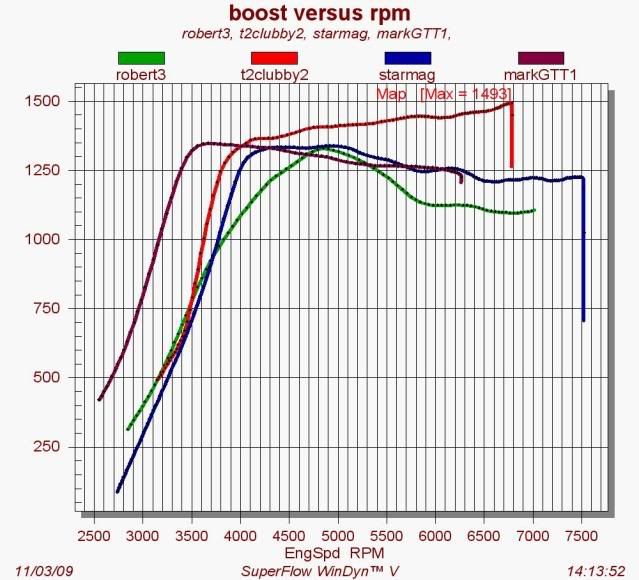
Robert is running the GT1752 and the others are T3 or T2 hybrids. I beleive that Matt uses a T3 hybrid turbo but probably uses a lot of later stuff. Plus we never know how much boost he runs. Saul Bellow - "A great deal of intelligence can be invested in ignorance when the need for illusion is deep."
|
|||||
|
8604 Posts Member #: 573 Formerly Axel Podland |
11th Oct, 2010 at 04:03:38pm
This is the difference in the turbine wheel design on a T2 and a GT17. Not sure if the T3 is similar to the T2.
Saul Bellow - "A great deal of intelligence can be invested in ignorance when the need for illusion is deep."
|
|||||
 6754 Posts Member #: 828 Post Whore uranus |
11th Oct, 2010 at 11:33:48pm
i think that the ve effect of organ pipe and inertial gas flow into and out of the cylinders , is very much active and working .i definately do not agree with the idea that because its a turbo engine these things no longer have any effect .whatever the pressure , pulses are still being created .
Medusa + injection = too much torque for the dyno ..https://youtu.be/qg5o0_tJxYM |
|||||
|
1497 Posts Member #: 100 Parisien Turbo Expert Paris\' suburb |
12th Oct, 2010 at 05:29:56am
Finally he came out of his jungle.. :)
|
|||||
|
8604 Posts Member #: 573 Formerly Axel Podland |
12th Oct, 2010 at 10:34:39am
On 11th Oct, 2010 robert said:
i think that the ve effect of organ pipe and inertial gas flow into and out of the cylinders , is very much active and working .i definately do not agree with the idea that because its a turbo engine these things no longer have any effect .whatever the pressure , pulses are still being created . I think that it has a lesser effect, which is what I thought I said above. My thoughts were that because the runners were so much shorter than the optimum that the pulse are coming back too quick in the useable rev range. This would apply to the inlet and exhaust. You certainly don't get the same pulses as a decent LCB. Food for further thought though. Saul Bellow - "A great deal of intelligence can be invested in ignorance when the need for illusion is deep."
|
|||||
|
1497 Posts Member #: 100 Parisien Turbo Expert Paris\' suburb |
12th Oct, 2010 at 01:57:14pm
Robertonator,
|
|||||
|
6754 Posts Member #: 828 Post Whore uranus |
12th Oct, 2010 at 05:56:26pm
On 11th Oct, 2010 Paul S said:
In a naturally aspirated engine, the air is pushed into the cylinder by atmospheric pressure, it has to get through the carb, ports and inlet valve. Also there may be some residual exhaust gas left over from the last cycle. So 100% VE is highly improbable. no not true ,at pk torq ve can get higher than 100 ,see below lol paul said:
Highly tuned naturally aspirated engines use modified heads to minimise the pressure loss through the intake system. This improves VE to a point beyond which it is necessary to use inertia effects on the inlet and pulse tuning on the exhaust system. It is possible to achieve more than 100% VE by using inertia of the inlet to help fill the cylinder even after the piston has started the compression stroke. Pulse tuning on the exhaust can help to initialy scavenge the cylinder during valve overlap, then provide a slight back pressure pulse as the exhaust valve is closing to help cylinder filling. is it me , or are you contradicting yourself here ? paul said:
When it comes to turbocharged engines, we do not have inlet inertia of any great amount. Neither do we have tuned exhaust systems. So we are much worse off in VE terms from that perspective. Furthermore, using inefficient turbos will create significant back pressure on the engine, higher than the boost pressure, that restricts cylinder filling. au contraire , i think we have oodles of inertia ,and a very effective tuned exhaust ,,maybe just not tuned for the correct rpm . regarding turbo's ..a lot is said about 'gt' this or that ..your looking at ,on the compressor side ,maybe the diference of a few percent ..betwen a gt or a t3 or watever ..in fact ,an old t3 with a e flow 50 series wheel would actually be a match for any gt i think . turbine wise , i think the power band is wider with a gt turbine , but if used with the right sized a/r , a t series turbo could i think outperform a gt at sheer acceleration ,once on boost .i think the gt series thing has become a bit of a band wagon .a lot of t3 probs come down to overall engine combo's . turbo response on the other hand ,eg off boost and then on again at ,say 4000 rpm,is totally different with the gt .and for street use . i find preferable .but with the t3 , i had boost coming in at 1800 rpm .no problem .(.25 a/r) fab . im taking the boost signal for logging from the vacuum line to the brakes .so just about 2 cm towards the engine from the carb mounting face . Medusa + injection = too much torque for the dyno ..https://youtu.be/qg5o0_tJxYM |
|||||
|
8604 Posts Member #: 573 Formerly Axel Podland |
12th Oct, 2010 at 06:00:16pm
Ok, the first statement should have had the term "standard naturally aspirated".
Saul Bellow - "A great deal of intelligence can be invested in ignorance when the need for illusion is deep."
|
|||||
|
8604 Posts Member #: 573 Formerly Axel Podland |
13th Oct, 2010 at 01:10:45pm
We had a big (ish) discussion about inlet runner length and pulses last year:
Saul Bellow - "A great deal of intelligence can be invested in ignorance when the need for illusion is deep."
|
|||||
|
8604 Posts Member #: 573 Formerly Axel Podland |
13th Oct, 2010 at 04:16:42pm
An afternoon researching pulse theory has revealed two very interesting facts. Maybe boring to some though Saul Bellow - "A great deal of intelligence can be invested in ignorance when the need for illusion is deep."
|
|||||
|
2498 Posts Member #: 1954 Post Whore Luton Bedfordshire |
13th Oct, 2010 at 06:15:29pm
Own the day
|
|||||
|
1267 Posts Member #: 831 Post Whore Montreal, Canada |
13th Oct, 2010 at 06:34:40pm
On 13th Oct, 2010 Mr Joshua said:
On 11th Oct, 2010 Paul S said:
In a naturally aspirated engine, the air is pushed into the cylinder by atmospheric pressure, it has to get through the carb, ports and inlet valve. Also there may be some residual exhaust gas left over from the last cycle. So 100% VE is highly improbable. I have to question this statement as it confuses the issue ever so slightly. Surely the inlet charge is induced into the cylinder by the radidly retreating piston hence why we see a vaccume in the inlet manifold. There is nothing questionable about the statement. There is a volume that needs to be filled and the only thing that will fill it is atmospehric pressure. The only thing that the retreating piston is doing is making this volume available and the fact that it is rapidly retreating just means that the volume is there faster which means the atmospheric pressure has to fill it faster and the restrictions have more influence. What you call vacuum is actually simply lower pressure. And what is happening is simply that the pressure will try to go to an equilibrium between the places with different pressures. That results in air movement with all the dynamics associated with it. Jean EDIT: I should correct my statement that the last sentence may be questionable but what is questioned here is not Edited by jbelanger on 13th Oct, 2010. |
|||||
 1137 Posts Member #: 1450 Post Whore Near Paris - France |
13th Oct, 2010 at 10:20:04pm
But then why would we delay the closure of the valve on the inlet stroke after the volume has started to reduce ?
Rusty by nature
On 23rd Jun, 2008 paul wiginton said:
They said "That sounds rough mate." I said "Cheers it cost me a fortune to make it sound like that!" |
|||||
|
8604 Posts Member #: 573 Formerly Axel Podland |
14th Oct, 2010 at 11:57:52am
On 13th Oct, 2010 Advantage said:
But then why would we delay the closure of the valve on the inlet stroke after the volume has started to reduce ? I understood there was a momentum in the inlet that could allow under specific conditions an overfilling of the cylinder a little above atmospheric pressure. Might be wrong but it is stated in numerous places ??? Maybe I am too tired to post .. That is true. Not sure what your issue is. Saul Bellow - "A great deal of intelligence can be invested in ignorance when the need for illusion is deep."
|
|||||
| Home > Technical Chat > VE of an A series | ||||||
| ||||||


 just jesting a bit ,

